Staying Human in an Automated World
AI is quietly changing how the online world works.
Not just through chat tools, but through something called AI agents that can now execute tasks, publish content, and run workflows in the background.
For heart-led entrepreneurs, that shift raises a deeper question: how do you stay human in an increasingly automated environment?
The online landscape feels different from what it did even a year ago.
If you are a heart-led entrepreneur, an intuitive, or someone who works closely with energy, you have probably felt this.
AI is everywhere right now.
For some people, that feels exciting. For others, it feels intrusive. And for many in the spiritual and heart-led space, there is a quiet resistance sitting just under the surface.
I don’t see that resistance as ignorance. I see it as protection.
Many heart-led entrepreneurs equate automation with inauthenticity. They worry about losing their voice. They do not want to automate the connection. They feel the speed of change, and something in their system tightens. It can feel fast and impersonal, slightly disconnected from embodied presence.
That makes sense to me.
But something specific is shifting right now. From where I sit, it feels more helpful to understand it calmly than to react to it.
From Conversation to Execution
Until recently, most people experienced AI in a fairly contained way.
You asked a question. It responded. It helped you draft something and clarified your thinking. It stayed in the realm of conversation, and you were still very clearly the one steering.
What is emerging now feels different.
AI agents are not just designed to respond. They are designed to act.
Some can open browsers, click links, run software, publish content, send messages, and complete multi-step tasks with limited instruction. They can follow sequences and execute workflows without needing a prompt at every stage.
That is not just faster thinking. It is a shift from assistance to execution.
For online businesses and social media, that means the environment itself is becoming more automated. Content can be created, scheduled, optimised, and interacted with at scale, often with very little visible human effort.
That does not mean humans are disappearing. But it does mean the landscape we are building inside is changing.
We Have Seen Format Shifts Before
When I zoom out, this does not feel entirely new.
Music moved from vinyl to cassette to CD to downloads to streaming in what felt like a very short span of time. Each shift disrupted the previous format and changed how music was shared and consumed.
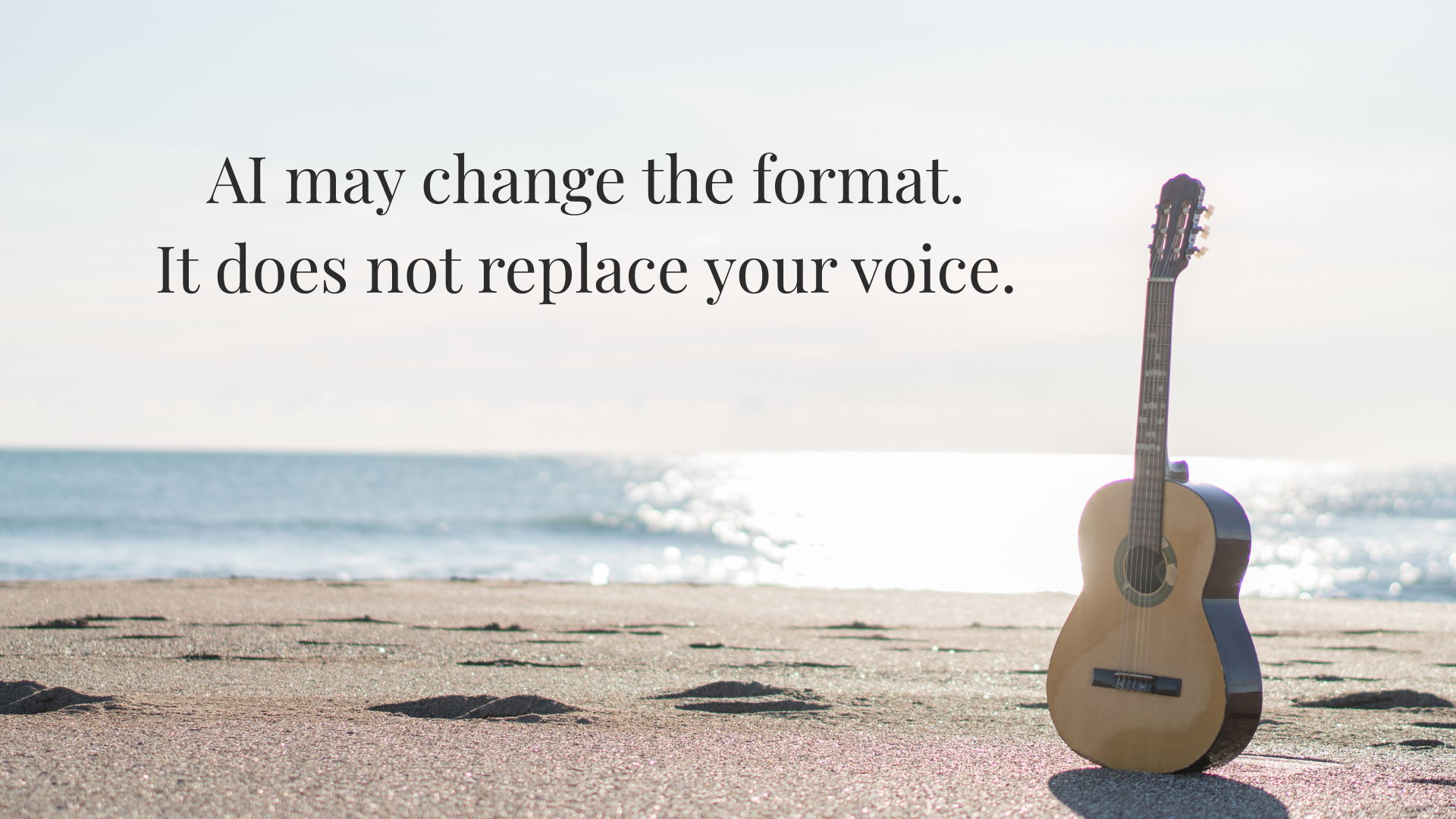
The distribution method evolved rapidly. The instrument did not.
If you had a guitar, a piano, or a voice, you could still create music. What changed was how you chose to send it out into the world.
AI feels like that kind of shift.
The format may change. Your voice remains the instrument.
You Do Not Have to Love AI
You do not have to love AI.
You do not have to automate your business or experiment with every new tool that appears. And you certainly do not have to override your own discomfort just to keep up.
But ignoring the format entirely does not stop it from evolving.
So the question, at least the one that feels more useful to me, is not how fast you can integrate AI. It is how you remain aligned while the landscape changes around you.
The Real Risk Is Not AI
I don’t actually think the risk is AI itself. From what I see, the real risk is much quieter. It is slowly outsourcing your own voice without noticing.
As more automation enters the online space, there is a subtle temptation to let structure replace discernment, to let speed override capacity, and to let efficiency substitute for embodiment.
That is where the tension lives for heart-led entrepreneurs.
AI can amplify structure. It can organise thinking, accelerate production, and extend reach. But it does not replace lived experience. It does not generate embodied presence. It does not build trust on its own.
This is the heart of what I call the Triple AAA Method. Alignment comes before automation. Authenticity comes before amplification. AI is support, not substitution.
When alignment holds, tools remain tools. When authenticity is steady, amplification does not distort your voice. And when discernment leads, automation does not erode your integrity.
As Automation Expands, Humanity Becomes Distinct
Some heart-led entrepreneurs are actively resisting AI because they fear becoming mechanical. They worry about losing the human quality that makes their work meaningful or being swept into a faster, louder, more synthetic online world.
I understand that.
And yet, as automation expands, something quieter is happening alongside it.
Emotion is becoming easier to manufacture. Stories can be generated. Sentiment can be replicated. Intensity can be scaled.
But coherence over time cannot be automated.
Regulated presence cannot be mass-produced.
Human congruence is becoming rarer, and when something becomes rare, it often becomes more valuable.
Presence becomes easier to notice. Regulated energy feels more stabilising. A clear identity stands out more clearly against a backdrop of optimised, automated output.
You do not need to compete with machines on speed. Your edge has never been volume or velocity. It has always been your ability to create safety, clarity, and trust.
As AI agents take on more execution tasks in the background of the internet, the visible layer may feel smoother and more refined. But what will actually cut through is not perfection.
It is coherence.
The Real Advantage
This is not a call to adopt every tool. It is not a warning about being left behind. It is not a rejection of technology.
It is simply an invitation to stay aware of the world you are building inside.
Formats evolve. Platforms accelerate. Automation increases.
Your voice is still the instrument.
And perhaps, instead of asking how to keep up with AI, you might ask:
What part of my visibility is truly mine?
Where am I using tools as support, and where might I be outsourcing identity?
What would alignment look like for me inside this evolving landscape?
The world may become more automated.
But what people really respond to, what helps them feel safe and understood, still comes from a real human being on the other side.
And that part is still yours.